
IALA buoyage: a visual Region A revision guide

IALA buoyage uses standard colours, shapes, topmarks and lights so that sailors can recognise what a mark means. UK waters use Region A lateral marking. Cardinal marks use the same system in both Region A and Region B.

Safety note: this page covers IALA Region A. Buoyage recognition does not replace up-to-date charts, local notices and information, pilotage or professional instruction.

Region A and Region B: what changes?

  • Region A (including UK waters): port = red, starboard = green.
  • Region B (for example, the Americas): port = green, starboard = red.
  • Cardinal, isolated danger, safe water, special and emergency wreck marks are the same in both.

Remember: lateral colours apply in the conventional direction of buoyage. That direction is shown on charts and nautical documents. It is normally the direction taken when approaching a harbour, river, estuary or other waterway from seaward, or otherwise as established by the competent authority. Check the chart and local information for the direction in use.

Lateral marks in Region A

Lateral marks show the sides of a channel.

Port-hand mark

Meaning
Marks the port side of the channel when travelling in the conventional direction of buoyage.
Shape & Colour Characteristics
Red. Can, pillar or spar; topmark, if fitted, a single red can.
Light characteristics
Red, any rhythm other than composite group flashing (2+1).
Starboard-hand mark

Meaning
Marks the starboard side of the channel when travelling in the conventional direction of buoyage.
Shape & Colour Characteristics
Green. Conical, pillar or spar; topmark, if fitted, a single green cone, point up.
Light characteristics
Green, any rhythm other than composite group flashing (2+1).
Preferred channel to starboard

Meaning
Where the channel divides, the preferred channel is to starboard. Treat it as a port-hand mark. If following the preferred channel, leave the mark to port.
Shape & Colour Characteristics
Red with one broad green horizontal band. Can, pillar or spar; topmark, if fitted, a single red can.
Light characteristics
Red, composite group flashing (2+1).

Preferred channel to port

Meaning
Where the channel divides, the preferred channel is to port. Treat it as a starboard-hand mark. If following the preferred channel, leave the mark to starboard.
Shape & Colour Characteristics
Green with one broad red horizontal band. Conical, pillar or spar; topmark, if fitted, a single green cone, point up.
Light characteristics
Green, composite group flashing (2+1).

Cardinal marks: North, East, South, West

A cardinal mark is named after its quadrant from the danger. Safe water is on the named side of the mark.

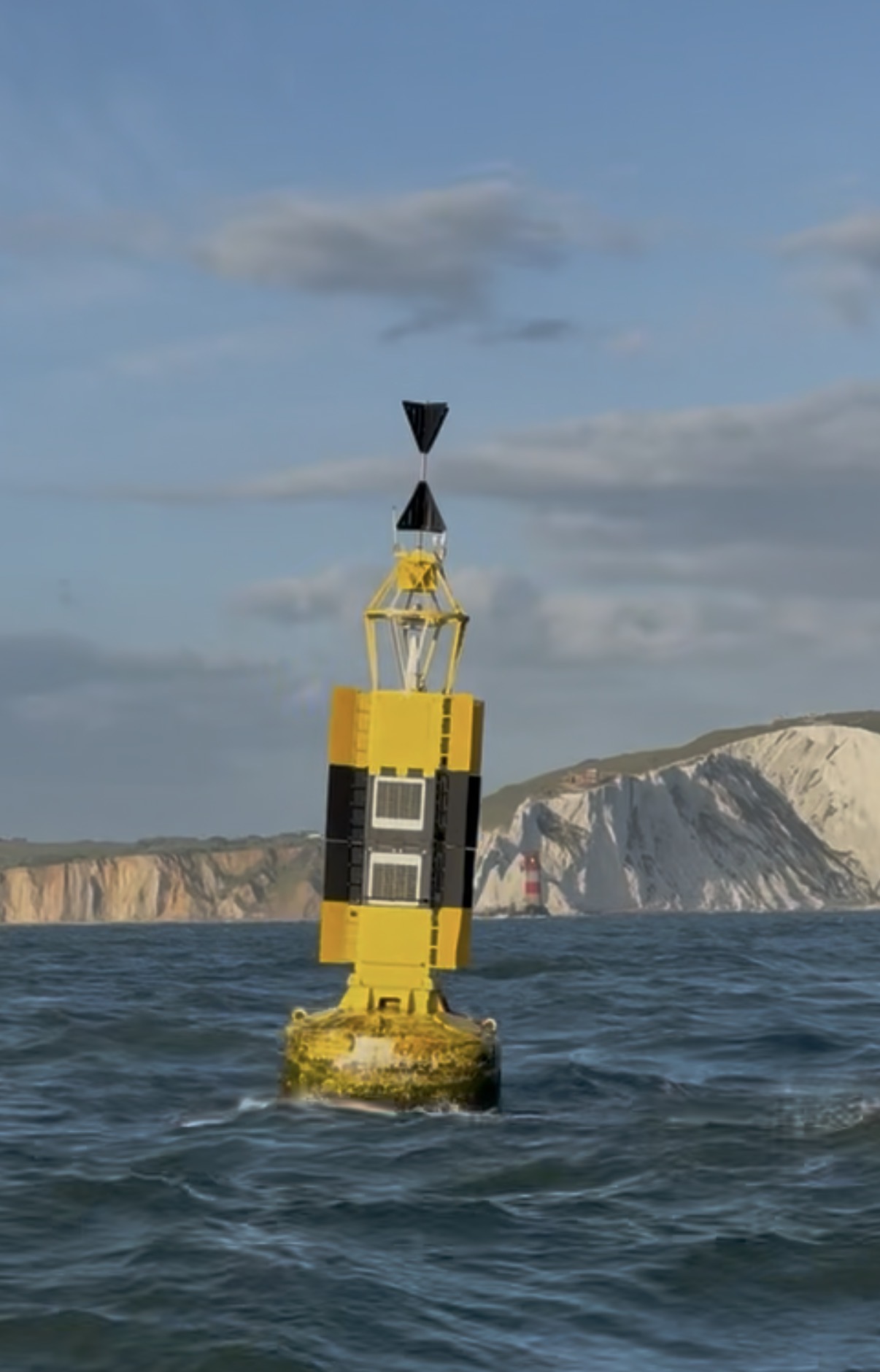
Photograph of Bridge, a West Cardinal mark near The Needles, Isle of Wight.
Bridge, a West Cardinal mark near The Needles, Isle of Wight — a real-world cardinal mark example.

North cardinal

Meaning
Safe water is to the north of the mark.
Shape & Colour Characteristics
Black above yellow. Pillar or spar; topmark two black cones, both points up.
Light characteristics
White, very quick or quick, uninterrupted.

East cardinal

Meaning
Safe water is to the east of the mark.
Shape & Colour Characteristics
Black with one broad horizontal yellow band. Pillar or spar; topmark two black cones, base to base.
Light characteristics
White, VQ(3) every 5 seconds or Q(3) every 10 seconds.

South cardinal

Meaning
Safe water is to the south of the mark.
Shape & Colour Characteristics
Yellow above black. Pillar or spar; topmark two black cones, both points down.
Light characteristics
White, VQ(6) + long flash every 10 seconds or Q(6) + long flash every 15 seconds.

West cardinal

Meaning
Safe water is to the west of the mark.
Shape & Colour Characteristics
Yellow with one broad horizontal black band. Pillar or spar; topmark two black cones, point to point.
Light characteristics
White, VQ(9) every 10 seconds or Q(9) every 15 seconds.

Other marks

Isolated danger mark

Meaning
Marks a small, isolated danger with navigable water all around it.
Shape & Colour Characteristics
Black with one or more broad horizontal red bands. Pillar or spar; topmark two black spheres, one above the other.
Light characteristics
White, group flashing (2).
Safety note
The mark does not show how far the danger extends or a safe passing distance. Check the chart and nautical publications.

Safe water mark

Meaning
Safe water all around the mark, for example a landfall or mid-channel mark.
Shape & Colour Characteristics
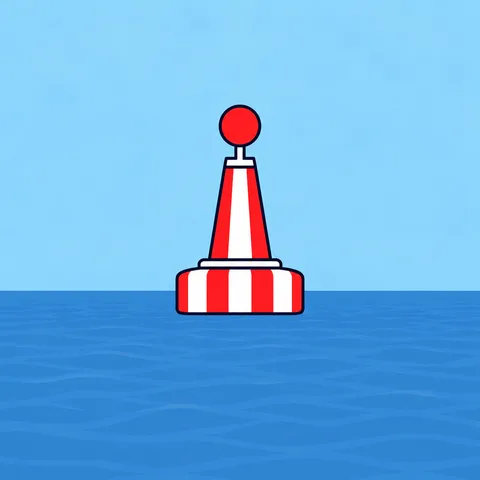
Red and white vertical stripes. Spherical, pillar or spar; topmark, if fitted, a single red sphere.
Light characteristics
White: isophase, occulting, one long flash every 10 seconds, or Morse “A”.

Special mark

Meaning
Marks a special area or feature shown on charts or other nautical documents. Not a channel mark.
Shape & Colour Characteristics
Yellow. Shape optional but must not conflict with navigational marks; topmark, if fitted, a single yellow X.
Light characteristics
Yellow, with a rhythm other than those reserved for cardinal, isolated danger and safe water marks or other specifically reserved signals under the IALA system.

Emergency wreck marking buoy

Meaning
Temporarily marks a newly discovered wreck hazard.
Shape & Colour Characteristics
Blue and yellow vertical stripes. Pillar or spar; topmark, if fitted, an upright yellow cross.
Light characteristics
Alternating blue and yellow flashes: nominally 1 second blue, 0.5 second eclipse, 1 second yellow, 0.5 second eclipse (3-second cycle).
StandOn revision card illustration of a red and white vertically striped safe water mark with a red sphere topmark, on a blue sea under a pale sky.
Example StandOn revision card: safe water mark.

Recognition method

  1. By day, start with colour and pattern, then confirm with shape and topmark.
  2. At night, identify the light colour, then time its rhythm and period.
  3. Match what you see to the chart, and check the direction of buoyage for lateral marks.

Practise buoyage from memory

StandOn Practice asks you to recall marks, topmarks and light characteristics from memory, repeatedly over time. Buoyage is live in beta. See the live question bank, or read how buoyage fits into Day Skipper knowledge.

StandOn is an independent sailing revision platform and is not affiliated with or endorsed by the Royal Yachting Association. StandOn is not affiliated with or endorsed by IALA.